Category: AI in HR

  • How Frontline-Heavy Industries Can Integrate AI with UKG, Workday, or SAP SuccessFactors

    How Frontline-Heavy Industries Can Integrate AI with UKG, Workday, or SAP SuccessFactors

    If your workforce punches a time clock, works in rotating shifts, or operates across multiple sites, you already know that standard HR platform features weren’t built with you in mind.

    Healthcare organizations managing 24/7 scheduling. Manufacturing facilities juggling shift differentials and union rules. Retail chains handling high turnover and seasonal staffing. These environments share one common frustration: their HCM handles payroll and compliance fine, but falls short everywhere the workforce gets complex.

    That’s exactly where AI integration makes the biggest difference — and where platforms like UKG, Workday, and SAP SuccessFactors have the most room to grow.


    Why Frontline Workforces Need More From Their HCM

    Standard HCM platforms are designed around a fairly predictable employee model: salaried workers, fixed schedules, desktop access. For office-based teams, that works well.

    For frontline-heavy industries, the reality is different:

    • Employees may not have email addresses or regular computer access
    • Shift changes, overtime rules, and site-specific compliance requirements vary constantly
    • HR queries — “What’s my PTO balance?” “Can I swap Thursday’s shift?” — come in high volume from workers who have no easy way to self-serve
    • Scheduling conflicts and missed punches generate significant manual work for supervisors and HR teams alike

    These aren’t edge cases. For healthcare, manufacturing, retail, hospitality, and logistics organizations, this is the daily operating reality. And most HCM platforms, even robust ones, offer limited out-of-the-box support for it.


    What AI Integration Actually Solves in These Environments

    Integrating AI with your existing HR platform — without replacing it — directly addresses the friction points that frontline operations teams live with every day.

    Here’s what that looks like in practice:

    Automated shift and scheduling workflows Instead of supervisors manually resolving scheduling conflicts or filling last-minute openings, AI handles assignment logic based on your rules — availability, certifications, overtime thresholds, union agreements. The HCM stays updated. The manual work disappears.

    Self-service access for employees without desks A tablet-based kiosk or mobile interface — powered by AI and connected to your HCM — lets frontline workers check schedules, request time off, view accruals, and get answers to HR questions on the floor, without calling anyone. One organization reduced missed time punches from over 25% per week to under 5% after deploying this kind of connected self-service layer.

    Conversational AI for HR queries An AI assistant trained on your HR policies handles the repetitive questions that flood HR inboxes — benefits questions, PTO rules, onboarding steps — instantly and accurately, at any hour.

    Compliance automation by site, role, or agreement Frontline operations often have location-specific labor rules or collective bargaining requirements that generic HCM workflows can’t accommodate. AI-driven automation handles these as configured logic, not manual exception management.


    The Integration Approach That Doesn’t Disrupt Operations

    For industries where systems downtime or process disruption is not an option, the integration model matters as much as the capability.

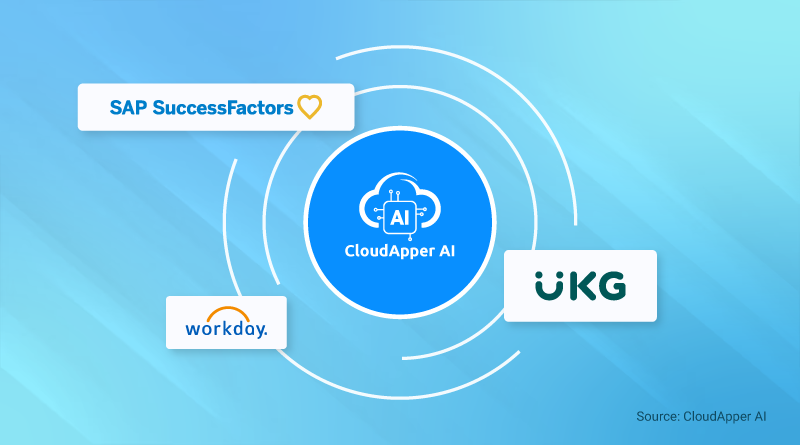
    CloudApper WorkBridge is built to extend UKG, Workday, SAP SuccessFactors, and other major HCM platforms from the outside — connecting via API and adding AI capabilities without modifying the core system. Nothing in your existing platform changes. Your data stays where it is. WorkBridge adds the workflows, self-service tools, and automations on top.

    For HR and operations teams in complex workforce environments, this means:

    • No risk to a live, business-critical system
    • No IT dependency to build or change workflows
    • No waiting on vendor roadmaps to get functionality your workforce needs now
    • Customizations that survive platform updates and vendor migrations

    The full technical breakdown of how AI integration works across these platforms is covered here: How to Seamlessly Integrate AI with HR Platforms Like UKG, Workday, or SAP SuccessFactors


    Where to Start

    If your organization runs a frontline-heavy workforce, the fastest path to value is identifying the single highest-friction point between your employees and your HCM — and fixing it first.

    For most teams, that’s one of three things: a self-service gap, a scheduling workflow, or a compliance exception process that’s being handled manually. Pick one. Deploy a WorkBridge solution for it. Measure the result. Then expand.

    That’s a faster, lower-risk path than any platform evaluation — and it makes your existing HCM investment work harder immediately.

    Explore CloudApper WorkBridge to see how it’s being used in healthcare, manufacturing, retail, and other frontline-heavy environments today.

    Ready to close the gap between your HCM and your workforce? Get started with WorkBridge →
  • How to Build a Workday AI Chatbot That Cuts HR Costs and Boosts Productivity

    How to Build a Workday AI Chatbot That Cuts HR Costs and Boosts Productivity

    TL;DR:

    A Workday AI Chatbot empowers employees to resolve HR queries instantly through natural conversation. It handles leave requests, payroll questions, benefits, and more — significantly lowering HR workload while improving the overall employee experience.

    Workday is a robust HCM system, but many organizations still deal with high volumes of repetitive HR inquiries. Employees often avoid the standard self-service portal due to its complexity, resulting in overloaded HR inboxes and increased operational costs. A smart Workday AI Chatbot directly tackles this challenge by offering an intuitive, conversational alternative that connects seamlessly with Workday data.

    Why a Workday AI Chatbot Is a Game-Changer

    HR departments supporting Workday environments spend countless hours answering basic questions. An intelligent Workday AI Chatbot uses natural language processing to understand intent and deliver accurate responses around the clock. This reduces ticket volume, frees HR professionals for strategic work, and maximizes the value of the Workday platform.

    Core Benefits:

    • Sharp reduction in HR operational costs
    • 24/7 instant support for employees
    • Higher employee engagement and satisfaction
    • Better adoption of Workday self-service features
    • Secure and compliant handling of sensitive data

    Simple Steps to Build Your Workday AI Chatbot

    1. Identify Key Employee Needs Focus on frequent requests such as leave balance checks, time-off submissions, payslip access, attendance tracking, and benefits information.
    2. Choose a No-Code Workday Integration Tool Select a specialized platform that connects easily with Workday without requiring developers or complex coding.
    3. Set Up Secure Integration Link the chatbot directly to your Workday tenant for real-time information and secure transaction processing.
    4. Test, Monitor, and Refine Launch with essential features, review conversation data, and continuously improve the chatbot’s performance.

    CloudApper hrGPT provides a fast, effective solution for building a powerful Workday AI Chatbot tailored to your organization’s needs.

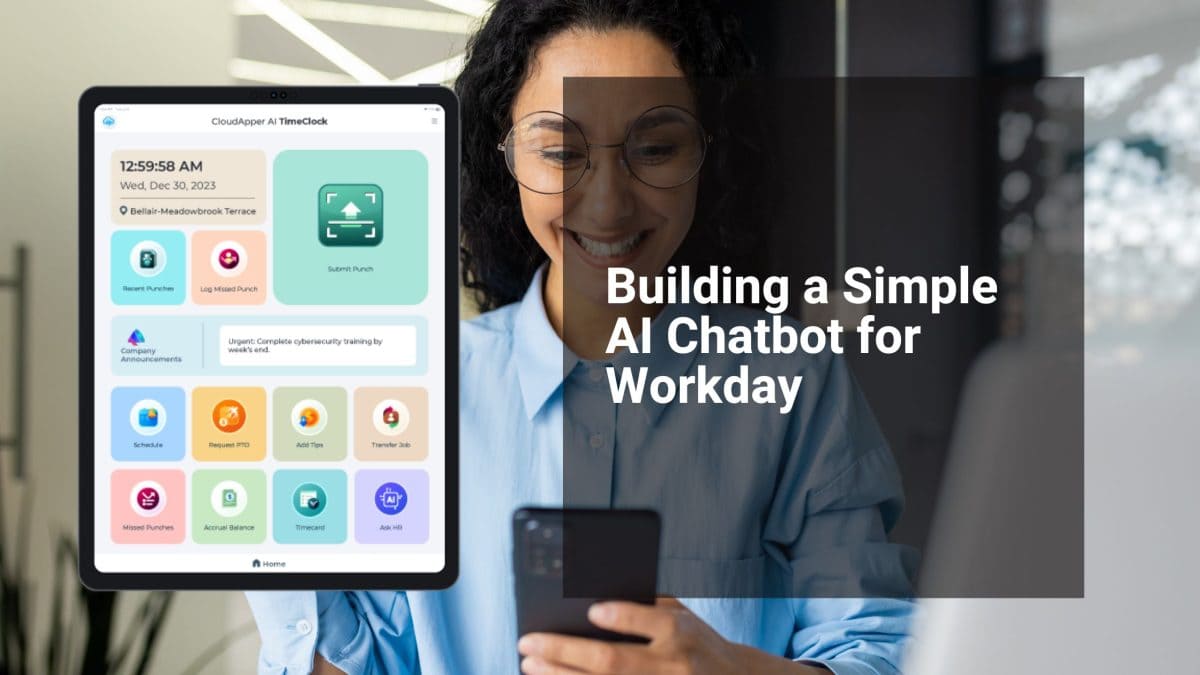
    For a complete employee self-service solution, integrate your chatbot with intelligent time tracking. Discover the CloudApper AI TimeClock for Workday, offering touchless biometric clocking with AI assistance for effortless attendance and payroll.

    Final Thoughts

    A Workday AI Chatbot is one of the most effective ways to reduce HR costs, streamline operations, and deliver modern self-service employees expect. It transforms how your workforce interacts with HR and unlocks greater ROI from your Workday investment.

    Ready to get started? Read the original step-by-step guide: Building a Simple AI Chatbot for Workday.

  • Closing Skill Gaps Before They Cost You: How AI Turns Reactive HR Training into Proactive Talent Power

    Closing Skill Gaps Before They Cost You: How AI Turns Reactive HR Training into Proactive Talent Power

    AI in Training and Development in HR is quietly delivering one of its highest-ROI advantages: proactive, real-time skill gap closure that stops capability shortfalls from turning into missed deadlines, stalled projects, or lost talent.

    Unlike traditional assessments that happen once a year (if at all), cutting-edge AI continuously evaluates employee proficiency through smart, conversational questioning—mapping current skills against role demands, upcoming projects, and individual career trajectories. It then instantly prescribes the most effective interventions: micro-courses, peer mentoring suggestions, hands-on labs, or external certifications—delivered at the exact moment the gap is identified.

    A mid-sized IT company put this into practice with CloudApper hrGPT and witnessed rapid, measurable change. The platform’s dynamic skill profiling narrowed disparities across engineering, product, and support teams; routed people to highly relevant resources without HR intervention; and kept compliance training current automatically. Employees felt genuinely supported in their growth, driving a 40% increase in training satisfaction scores. Meanwhile, the administrative overhead of coordinating, tracking, and reporting on development activities dropped by 60%—freeing HR to focus on leadership development, diversity initiatives, and strategic workforce planning.

    This predictive approach doesn’t just fix problems faster; it builds organizational resilience by ensuring the right capabilities are always in place exactly when they’re needed.

    For the complete overview of AI’s role in modern training—including skill-gap tactics, personalization strategies, compliance automation, and real implementation stories—read the in-depth guide here: How Is AI Used in Training and Development in HR.

    Ready to stop reacting to skill gaps and start preventing them? Explore how CloudApper hrGPT makes proactive talent development simple and powerful—download the brochure today and see the difference it can make for your organization.